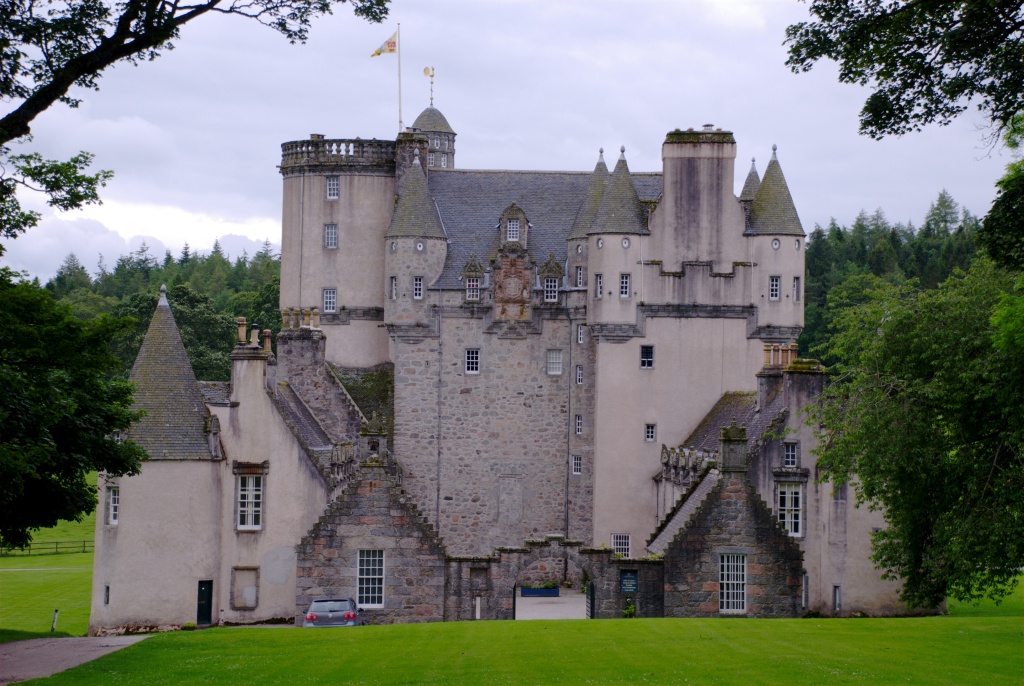

Castle Fraser, built from local granite, lies 15 miles west of Aberdeen between the villages of Sauchen and Kemnay, two miles south of the river Don in the Grampian area of Scotland. The original building most probably dates from the middle of the fifteenth century and is a substantial stone tower on the traditional Z plan. It was remodelled in the sixteenth century, and master mason Thomas Leiper and John Bell produced one of the most magnificent castles of its type. The ravages of the civil wars left the castle unscathed, though it was 'spoiled' by Montrose in 1644. The first Lord Fraser was created by Charles I, but despite various vicissitudes, dependants lived there until the death of Elyza Fraser in 1814. The castle then passed by an indirect line of succession to Charles Mackenzie Fraser, Elyza's great-nephew. He married Jane Hay of Haystoun, Peebleshire, and set in hand various modifications to the buildings. When he died in 1871 the castle passed to his son, Colonel Frederick Mackenzie Fraser, who died in 1897 'without issue'. After being left in the hands of trustees, the Castle was bought in 1922 by Lord Cowdray for his second son, the Hon Clive Pearson, whose granddaughter, Lavinia Smiley, made the building over to the National Trust for Scotland in 1976. Although the building itself came into the hands of the National Trust for Scotland, the library, including the music collection, remained in the hands of the family – as it does to this day.(1)
The CollectionAt the Castle there is a fabulous and extensive collection of music, remarkable in its scope and noteworthy for its family associations.(2) On entering the Castle today, one of the first objects seen is the wheelchair that Charles Fraser used after he took up his inheritance of the Castle. He had his leg amputated as a result of a serious injury at the Spanish Peninsular battle of Burgos in September 1812.(3) One of the several legs he used is on display in the library, as is one of the bullets that lodged in his hat at that same battle.
More than four generations were involved with the music – Elyza Fraser in the eighteenth century, Charles in the early nineteenth, the children of Charles and his wife Jane, other relatives taking us to the middle of the nineteenth century, and finally through another generation to Monsignor Thomas Croft Fraser, an assistant organist at Brompton Oratory,(4) in the twentieth century. Additionally, Elyza had a companion Mary Bristow, who was a musician; Charles' two sisters and Jane's mother were musical, as were some of the in-laws. At least five of Jane and Charles' children were musical, and there were other more distant family members, as well as many friends and acquaintances, who shared their musical interests.(5)
There is a discrete eighteenth-century part to the Collection, a wide-ranging selection of highly varied music gathered in the early years of the nineteenth century, and a more limited selection of piano pieces and ballads from Victorian times. The collection also emphasises the importance of women to music in domestic situations – not only Elyza Fraser and Mary Bristow, but also Charles' two sisters Marianne and Helen, his wife Jane, her own mother and some of her siblings. The collection thus reflects music across an extended period, from the 1720s to the middle of the nineteenth, and further musical interest to the twentieth century. In Regency and Victorian times music was often regarded as an important social accomplishment, especially for young ladies, but also in preparation for the Grand Tour for young gentlemen. Undoubtedly there is something of this about the interest in music amongst the Frasers, their families and acquaintances. But from letters between family members and acquaintances, and diaries, we are able to build a picture of an interest in music that went well beyond what Patrick Piggott referred to as 'The Innocent Diversion'.(6) From the many copies that carry signatures, fingerings and other marks, and from the surviving correspondence between family members, we are sometimes able to trace who played what instruments, and who sang. From this internal evidence, we can deduce something of the importance that music played in the life of a geographically remote castle, in rural Aberdeenshire, in the early decades of the nineteenth century.
The collection begins when London was a burgeoning musical centre. This was a time when music was flourishing, with many establishments producing musical entertainments of various different types. There was opera ('If you hear any pretty new song at the Opera will you bring me a copy' wrote Jane to her husband Charles)(7) – several different companies existed from time to time. There were pleasure gardens (over 200 of these) of various different sizes and significance, and a growing market for music in the home. The concept of public concerts, begun with the Academy of Vocal Music, later renamed the Academy of Ancient Music (1726-1792), started off in the Crown and Anchor Tavern in the Strand. The Bach-Abel concerts (1765-81) introduced London audiences to symphonies and concertos from the continent, including from Mannheim. And it was this group that Wilhelm Cramer led from 1773. But there were many musical organisations, based on a mixture of professional and amateur players including the Anacreontic Society, the Caecilian Society and the Professional Concerts. These followed on from the Bach-Abel concerts with immigrants Clementi, Cramer and Salomon bringing the latest works to the Hanover Square Rooms.(8) Concerts were given in series, by subscription, such as the Salomon concerts to which Haydn was the great attraction in the 1790s.
To this ferment of musical activity were added a number of music publishing houses, many of which also sold or hired musical instruments. Through the records of some of these we glimpse something of the active market of hiring instruments for the 'season'.(9) And to this flourishing musical environment, many musicians (players and composers often being one and the same) were attracted, and many musicians came from abroad and settled in London, from where they often ventured out to the provinces. Singers from Italy had been frequent currency from much earlier in the eighteenth century, and a tradition of the bel canto singer performing and teaching in London continued well into the following century. Although there were some well-founded musical establishments in major churches of that time, the standard and breadth of music for Services seems to have been somewhat patchy. The use of churches for concerts, however, was certainly being developed as, for example, the enormous forces which were assembled for the Handel festivals in Westminster Abbey. It is against this background that we place the development of the music collection at Castle Fraser.
Signatures and OwnershipOne factor that makes this collection at Castle Fraser so rewarding is the large number of signatures, labels and other identifying features on many volumes. When combined with information compiled from the archives, about the various generations of the families involved with the Castle,(10) we are able to piece together quite a story about the music. The printed catalogue of music at Castle Fraser,(2) unlike those of other similar collections, is organised chronologically, based on ownership – or assumed ownership. Caution is advisable however when attributing ownership; it is sometimes all too easy to make assumptions regarding who acquired which volumes. Sometimes a signature will have to be interpreted in line with other information available. When there is evidence of much use of a particular copy, exactly who spilled the candle grease, who tore the page, or who added the pencil marks, might be difficult to work out. And although we may be reasonably certain that some copies were used by specific family members, others – 'pre-used' – might not actually have been touched by a family member at all.
From marks on copies we learn that items came from different family members, which helps explain duplicates. When Charles' two sisters from Hayes, Kent, died their music came to the Castle. Jane Fraser's mother had a significant collection, mostly bound in volumes with her name on the outside – very conveniently. Some of Jane's sisters were musical and their music seems to have come to the Castle.
Elyza Fraser and Miss BristowElyza Fraser and Miss Mary Bristow are responsible for the earliest volumes of music at Castle Fraser. Though we have no proof, we can intuit that one of them played the violin while the other a keyboard. Elyza Fraser (1734-1814) was the last direct descendant of the Fraser family, and she had a lifelong companion Mary Bristow (c.1740-1805), who was amongst the four sons and eleven daughters of John Bristow (1701-68), an English merchant, financier and politician. He sat in the House of Commons from 1734 to 1768 and acquired Quidenham Hall in Norfolk after 1740. One of his daughters, Caroline – i.e. sister of Mary – married William Henry Lyttleton (1724-1808) MP, the youngest son of Sir Thomas, 4th Baronet.(11)
The earliest volumes of music contain all four sets of Trio Sonatas and Concerti Grossi by the seventeenth century Italian composer Arcangelo Corelli {B23,24}.(12) Apart from the set of violin sonatas, Op.5, this represents a complete collection of Corelli's work – a testament to the popularity of his works in British musical circles. We see the importance attached to Corelli in the development of the Music Societies of the eighteenth century where, as in Aberdeen, each of the three parts of the evening were to contain one work of Corelli(13). The omission of Corelli's Violin Sonatas Op.5 is perhaps surprising. However, the Concerti Grossi published by Geminiani in 1726 are a reworking of those Op. 5 sonatas by Corelli. In a very real sense, the complete Corelli output is present. It is perhaps worth quoting the title page of these Concertos:
Geminiani was a pupil of both Corelli and Scarlatti, who, after playing in the Naples Opera Orchestra, lived in London from 1714, Ireland (1733-40, 1759-62) and Paris (1749-62).(14) He was responsible for spreading Corelli's works through performing, teaching and writing of tutors. Geminiani's original Concerti Grossi, Opp. 2 and 3, two sets of 6, are also included in this collection – and all in part books {B26} It is very interesting that these copies of Corelli and Geminiani at the Castle should be of such early editions, dating from the second and third decades of the eighteenth century.
A fascinating copy of an early edition (c.1738) of Handel's Organ Concertos, arranged as solos, contains several pencilled ornaments and gives the impression of being genuinely historical {B5}. Is this what remains of an oral tradition from the composer's own performances perhaps? Two complete operas are included – Rosina by William Shield, and The Deserter by Monsigny, Philidor & Dibdin {B30}.
Works by Johann Christian Bach, the youngest son of J. S. who, after time in Berlin and Italy, settled in London and was therefore known as the 'English' Bach, feature, with several sonatas {B4,B14,B21} and concertos {B1,B6,C2,C13,B1,B27}, as do sonatas by his first tutor and elder brother, C. P. E. Bach {B8}. There are also some overtures and symphonies by J. C. Bach, but it seems almost certain that they were acquired by the next generation. There is a group of symphonies Op. 13 by Charles Stamitz {B29}, a symphony by Haydn arranged for keyboard {B2}, and many original solo keyboard and chamber sonatas. These include some early editions of Haydn Opp.1 and 2, and the set of six Op. 6 by Pleyel, probably published in 1788 {B29}.
A broad swathe of composers is represented, some English, many foreign, and several who settled in Britain. They include works by Barber {B21}, Boyce {B28}, Eichner {B21}, Greene {B20}, Kammell {B1,B29}, Loechlin {B2}, Stabilini {B3}, Ignace Pleyel {B3}, Giordani {B1,B30}, Geminiani {B11,B12,B25,B26}, Haydn {B2,B29}, Kozeluch {B8}, Lampugnani {B28}, Martini {B28}, Mondonvile {B15}, Pleyel {B3}, Scherrer {B2}, Schroeter {B29}, Sterkel {B21,B27} and Wagenseil {B6}. Interestingly, two early volumes of Scarlatti sonatas from c.1748 {B7} and 1752 {B15} are included. These are by no means easy keyboard pieces, and it says something of the high technical accomplishments of this generation that these sonatas are present. There is a small choice of songs by diverse composers – Handel {B22}, Hook {B13}, William Jackson of Exeter {B3,B12}, Shenstone {B2} and Urbani's Scots Songs {B3}, and also less well remembered composers such as Millico, Rauzzini, Mortellari, Vento and Piccini in a volume from the mid 1770s {L23}.
Additionally there is a large collection of Psalms and church music including a complete copy of the enormous eight-volume set of Garth's Marcel Psalms of the first 51 psalms by Italian composer Benedetto Marcello, adapted to English versions by John Garth, published in 1757 {B16}. The second edition of Boyce's three volumes of Cathedral Music published in 1788 {B17} and Arnold's four volumes of Cathedral Music published in 1790 {B18} are also present. These three collections represent something rather special, and a large investment in music volumes from the end of the eighteenth century. It is not at all the sort of collection one might expect from a couple of spinster ladies living in the North East of Scotland.
The Hon'ble Mrs HayFrom the same generation, comes a group of around fifteen volumes which have a label 'The Honble. Mrs Hay'.(15) It is difficult to be certain exactly how many are in the sequence: the first has lost its label and some volumes are missing. The label is of Jane Hay's Mother Mary Elizabeth who was a daughter of James, 16th Lord Forbes. She married Sir John Hay, 5th Bart of Haystoun & Smithfield (Castle), Kings Meadows, Peebles, in July 1785. The title 'the Honourable' therefore comes from both sides of the family. There are many instances of the signature of Mary E. Hay, and one of Miss Forbes (i.e. her maiden name) {C6}. In a couple of later volumes there are signatures of Catherine Hay, which we assume is Jane's sixth sibling born c.1804 {C12,C15}.
These volumes contain wide-ranging music, from Italian and English songs by Ferrari, Paisiello, Winter and Shield {C1,C4,C14,C15}, to keyboard music with arrangements of overtures and symphonies by Haydn and Abel {C3,C5,C7}. There are concertos by J. C. Bach, Pleyel and Mozart {C2,C3,C12} – not only the solo keyboard parts, but instrumental parts {C13} too, suggesting that they might have been used in an ensemble. There are also sonatas by Barbieri {C8}, Pleyel {C13,C14}, Schetky, Kozeluch {C5,C9,C13}, Eichner {C6} and other contemporaries. One volume contains three books of Scottish reels, strathspeys etc. {C12}. This series of volumes represents a broad and catholic musical taste, with many items from the pleasure gardens repertoire. Most of the items were published in the last decade of the eighteenth century and the first few years of the nineteenth, and most were printed in London.
Charles FraserCharles Fraser came to live in the Castle from 1814. He had two sisters, Marianne and Helen, and a younger brother, Frederick Alexander. Though initially from Edinburgh, they were brought up in Hayes, near Bromley in Kent, because of the death of their mother, Helen, when they were 13, 11, 9, and 6 years of age respectively. All four children were brought up in the home of Lady 'Aunt' and Sir Vicary Gibbs, a major figure of the time – variously Member of Parliament, Privy Councillor and, from 1814, Chief Justice of Common Pleas. He had high social connections, not least with William Pitt the Younger who lived about a mile away. As might be anticipated, they had many friends in the legal profession, amongst whom were several who shared the family's musical interests. Through these connections music became important, and the family and the world of professional music become very close.(16)
In 1817 Charles married Jane Hay, daughter of Sir John and Mary Hay. Charles played the cello and music connected with him is particularly wide-ranging. He and his wife Jane, and their children, must have made a vibrant family at the Castle. This is the most important era for music there, a great deal of which came to the Castle over the next four decades.
Despite Charles Fraser dominating the musical collection, there are only a modest ten volumes directly attributable to his ownership. But these are of great interest. Two books of manuscript cello parts include pieces by Gluck, Handel, Mozart, Beethoven, Rossini and Weber, and Scots Songs {F2,F3}. A vocal score of Act Two of Mozart's Don Giovanni {F7} is on the shelf next to a copy of Beethoven's cantata Adelaide. There are two cello tutors which bear signs of use – one by John Gunn from 1780 and the other by Joseph Reinagle from 1800 {F4}. There is a volume with Charles Fraser's name on the outside, of Elizabethan Madrigals – The Triumphs of Oriana, with a watermark of 1815. This volume is actually not kept at the Castle but is at Parham House. It is interesting to note that the breadth of Charles' musical sympathies went back to Elizabethan times.
The astonishing heart of this part of the collection comprises a complete set of instrumental part-books of symphonies from the mid and late eighteenth century. There are 97 of an original collection of 209 works – the missing 112 seem to have been sold in a roup (auction) in the 1920s. From guesswork we can judge what some of these missing works probably were – Handel's 65 Overtures from all his Operas & Oratorios, Graaf Symphonies Op. XI, Geminiani's Concerti Grossi Op.2, and Four Overtures, Eight Overtures and Six Concertos by San Martini. But we do not know what the other 27 works might have been.
The works that have survived in the collection, however, were important in helping to define the emerging genre of the symphony in the late eighteenth century. They were given due public prominence in London in concerts at which the young Mozart was present in his visit in 1764. Wilhelm Cramer, father of Johann Baptist and Franz, came to London in the 1770s, and led the Bach-Abel concerts from 1773. Prior to his arrival in London, Willhelm Cramer was the lead violinist in the celebrated orchestra led by the Stamitz family in Mannheim. He retained his eminence as a solo violinist in demand in London and the provinces. His elder son (Johann Baptist) became a talented concert pianist who played to no less a person than Beethoven. The younger son (Franz) became a musician in great demand as leader of orchestras, as did his father in London and also in the provinces, and he rose to become the Master of the King's Musick in 1834 (NB not 1838, as some sources suggest)(17).
It is entirely credible that the collection of symphonies at the Castle might have been stimulated by the close friendship between the Frasers and the Cramers. From surviving letters we learn that these men, together with some friends from the legal world called Moysey, formed a small orchestra for family gatherings.(18) We surmise that Franz Cramer might have played Vn.1, one of the Moyseys Vn.2, J. B. Cramer viola and Charles cello, with miscellaneous guests playing wind and brass parts, and probably Marianne on continuo. It is understandable why the cello parts of several of these symphonies carry marks of fingering, revealing Charles' wish to practise his parts before playing alongside such distinguished musicians. In this collection of symphonies and overtures (there was frequently little or no difference between these two genres in the late eighteenth century), there are complete sets of works by C. E. Graaf Op. 11, from 1771, and J. C. Bach is particularly well represented with his overtures of 1763 and symphonies Op.3 of 1770.
Also included are works by C. F. Abel Op.7, P van Maldere Op.4, Franz Richter and F. Schwindl Op.1; there are Eight Overtures by Arne of 1751, and the first six volumes of pioneering sets of The Periodical Overtures printed and sold by R. Bremner in the 1760s. These include works by J. C. Bach, Stamitz, Pasquali, Filtz, Canabich, Kelly, Jommelli, Piccinni, Herschel, Pugnani, and others who helped to define the genre of symphony to contemporary audiences in London. Although these works are not unique, it is rare to find sets of instrumental parts outside a main performing collection of music {M1}. There are some rarities here as, for example, the symphonies by Pierre van Maldere. He was a composer born in Brussels in 1729 and died in 1768. He was a violinist with Prince Charles of Lorraine who went to Dublin and Paris.(14) The first in the set of six Op.4 is a splendid symphony in g minor, which has claims to be one of the first in the classical era in that dark and tragic key. Amongst other works are overtures, both those derived from larger stage works and those which (as in the case of Arne and J. C. Bach) stand alone as independent works.
From this same period of the late eighteenth century come collections of glees and catches {K1,K2}, reminding us of the prevalence of organisations devoted to such repertoire for their use at convivial gatherings, particularly at gentlemen's clubs.
There is a small group of programmes {F10} which includes several of the Concerts of Antient Music which were still going in 1835, when Charles (presumably) went to six of the series. Also in this group of programmes is An Account of the Musical Performances in Westminster Abbey and the Pantheon May ... 1784 ... to which is added A Notice of the forthcoming Royal Musical Festival of 1834. This was an occasion with a double significance for the Cramer family, as Wilhelm would have been involved with the first, in 1784, and Franz Cramer, his son, led the orchestra in the second in 1834. Considering the closeness of the Cramers and the Frasers there is no surprise that this programme is present.
MarianneFourteen volumes of music belonged to Charles' elder sister, Marianne, who lived at Hayes, near Bromley in Kent.(19) These volumes are identified by her initials MMF (i.e. Marianne Mackenzie Fraser). Whereas sonatas by Handel, Jomelli, Paradies, Schobert, Mozart, Boccherini {D3}, Kozeluch and others {D7} might be anticipated, two sets of the complete collection of Corelli's Trio Sonatas Opp.1-4 {D4,D7}, his sixth Concerto Grosso and the Twelve Trio Sonatas op.3 by San Martini are not {D1}. The latter were apparently a gift from Rowland Davies in 1757. One point of interest is that these works are here in their original parts. Also there are concertos by J.B.Cramer and W. Crotch {D7}.
There is a significant collection of sacred music, perhaps connected with Marianne playing the organ at Hayes Parish Church. These include the set of Forty Select Anthems by Maurice Greene, published around 1770, with Marianne's signature, dated 1816 {D2}. The massive three-volume set of La Trobe's Selection of Sacred Music from the works of the most eminent Composers of Germany and Italy was printed and sold by Robert Birchall in London in 1806 {D8,D9,D10}. There are two volumes of Psalms from 1837 and 1848 by Robert James and W. H. Warren, respectively {D12,D11}. The Hymn of Adam and Eve from Milton set to music by J. E. Galliard in 1728, is something of a rarity. There are also two manuscript volumes in Marianne's hand {D6,D13} which contain a variety of keyboard pieces, songs, responses and chants. From these volumes we have the distinct impression of a musician of very wide tastes from different periods and genres, ranging from ensemble to solo pieces – a broader selection of music than might be anticipated.
HelenCharles' other sister, Helen who suffered ill health for much of her life, is also represented by a smaller selection of music.(20) Amongst the six volumes which are connected to her are two volumes of songs by Handel {E1,E2}, Italian and English Songs (a volume presented to Jane Fraser from Helen) {E3}, and several volumes of sonatas, some solo but some with accompaniments, described as being for piano with accompaniments for a violin and cello, which we now call Trios. These are a mix of works by the known and the forgotten. Amongst them are several of the symphonies that Haydn wrote for his visits to London in the 1790s, arranged for Piano Trio. Though less well known than contemporary arrangements for quintet, they are reputed to be by Salomon himself, and apparently received the imprimatur of the composer. These copies give the impression of much use.
Jane Fraser (née Hay)An interest in Mozart is continued through Jane Fraser,(21) with a volume of the complete vocal score of Cosi fan Tutte labelled on the outside 'J. F. 1817' {G1}. A manuscript book with the inscription 'Jane Fraser Kingsmeadows, 10 July 1818' informs us that Jane went to her parents' house while pregnant with her first child, Alexander Mackenzie (b. October 1818). Presumably to help with the discomforts of late pregnancy, she copied out some favourite pieces, and this book offers a fascinating glimpse into her musical tastes. It contains 59 individual pieces culled from a wide variety of sources {G4}. There are pieces by Mozart, Rhone, Barbieri, Abel and Pergolesi in addition to Waltzes from Beethoven, airs from operas by various composers – Winter, Paisiello, Scottish and Jacobite songs, several Mazurkas and Minuets, pieces by Pleyel and Steibelt, and 'the celebrated trumpet tune played at executions' (a short piece of 16 bars). There is also a set of Three Polonaises for piano duet which, as they have not been attributed, might perhaps be original compositions.
There are fifteen volumes that carry Jane's signature, amongst which are several volumes of vocal music. The two volumes of Convito Armonico, with madrigals, Glees, Canons, and Catches compiled (and some written) by Samuel Webbe junior, were published in 1815 {G2}. Beethoven's cantata Christ on the Mont of Olives, in an edition from 1815, is included {G7}. A volume of sacred music – Chants, Psalm Tunes and Sanctusses, by J. H. Rogers – was published in Edinburgh {G6}. Although there are no features identifying ownership of the second edition of The Sacred Harmony or the Church of Scotland published in Edinburgh in 1835 {L32}, it seems likely that the volume belonged to this generation. There are several volumes of Italian songs which include many arias by Rossini and his contemporaries Majer, Cimarosa, Ferrari, Paisiello, Paer, Donizetti and Bellini {G5,G10}. There are English songs, one volume of which begins with songs by Mendelssohn {G12}, but continues with Zeta (seven items), Graeff, Bishop and Mrs Hemans.
Many of these copies carry markings, corrections and added ornaments {see G11}. The question has to be asked as to how much involvement there might have been with Aristide Verri, a singer to whom money was paid in 1842/3 for 'music tuition'.(22) Who was J. H. Allwood, described as Professor of Music in Aberdeen, who was paid in 1852/3?(23) A significant collection of piano trios by Beethoven is included, and the whole set of twelve London Symphonies by Haydn is included {G8 a,b,c} with the violin and cello parts, some of which give evidence of having been very well used. The survival of these, with their less than robust violin and cello parts, is something of a rarity. A volume of piano duets contains music from operas by Rossini (Mosé, Il Barbiere, La Gazza Ladra) and music by Cimarosa, Cramer and Haydn (Symphony no. 85) {G14}.
George ForbesThere are two manuscript books under the name of George Forbes,(24) the third son of Sir William Forbes, 6th Bart of Pitsligo {L24,L25}. Both volumes are neat copies of presumably otherwise printed works. The first is a volume of Madrigals by Antonio Lotti, originally from 1736, and the other of Twelve Duets by Benedetto Marcello. With the inscription of 'Roma, April 1818' we assume that this was Jane's cousin, who was to marry Mary Hay in 1819.
Jane's familyThere were several musicians amongst Jane's sisters and copies of music with their signatures are present. Catherine Hay(25), one of Jane's older sisters, added a signature to an edition of Haydn's two books of Canzonettas with paper dates of 1804 and 1810, and several added ornaments which are not recorded as having survived elsewhere {C17}. Several volumes seem to have been hers; included are some harp parts (was she a harpist?) and some rare organ voluntaries by the Edinburgh organist William Clarke {C18}. There is also a volume of piano duets which include Haydn's symphonies 53 and 63, excerpts from The Magic Flute by Mozart, and other individual items {C20}. There is a rare copy of a Serenade by J.B.Cramer, on paper dated 1806, for Piano, Harp and Flute – alas the only part included here is for the piano {C21}. A further point about Catherine Hay concerns a piece that was written by the Edinburgh-based harpist John Elouis titled 'Papa' which was dedicated to Miss C. Hay (see infra re the family Elouis).(26)
Jane and Charles' children and subsequent generationsAmongst Jane and Charles' children there are several who were interested in music. The one who has left the largest collection is Frederick ('Freddy'), who was born in 1831.(27) He inherited the Castle on Charles' death in 1871, until he passed away without issue in 1897. There are 10 volumes, either with his signature or assumed to have been used by him. They are of piano repertoire, many pieces are virtuosic. One volume {L9} comprises piano pieces bought entirely in The Hague, suggesting that he might have spent some time there. There is also a vocal score of the opera Rigoletto by Verdi dated 1861 {L7}. Several volumes of songs, start with an anonymous volume – Daily Exercises for the Voice {L4} – and continue with a selection of excerpts from Classical Composers chosen by B. Jacob, of around 1830 (a present from his aunt Marianne in 1852) {L3}. The collection continues with a mixture of serious and light-hearted songs and ballads of the mid-Victorian era {L5,L6,L8}. Bound up in these volumes are copies with the signature of his sister, Grace Harriet (1830-86), and an address: 47 Euston Square – about which there seems to be no information. In the same volume there is also a signature of Augusta Charlotte (1833-1911)(28) who married Robert Drummond, the banker, in 1854.
Catherine Fraser, the third child, (1820-56)(28) added her signature to the title page of The Scottish Minstrel Vol.III, originally published in 1810. An interesting letter written in French to her Father when she was around 13 years of age mentions learning the Overture Semiramide by Rossini by heart, but in case that sounds too impressive for a 13-year-old, she adds that it was just the bass part – i.e. of a piano duet. She does however go on to write something quite revealing about her sisters and the musical environment at the castle:
This seems to be the only reference we have to a private tutor. M[ademois]elle Elouis was one of the six daughters of the celebrated Edinburgh-based but French-born harpist and composer, John (baptised Joseph) Elouis. He had an international reputation as a performer and also built harps, and was resident in Edinburgh from 1805. He was active as a performer there and also as a teacher who charged high prices. He visited Aberdeen in October 1807. If this is the oldest daughter, she was Mary Anne Elouis born c.1800. She had been a pupil of Ferdinand Ries (1784-1838 – himself a pupil of Beethoven), while resident in London 1813-24. She had the reputation of being a fine pianist from her various appearances in Edinburgh. From the various Directories and the census of 1841, we learn that she was not resident in Edinburgh during 1837/8 – was this perhaps because she was resident at Castle Fraser(26)? It is certainly of interest that Catherine writes to Charles in the late 1830s about someone who insisted on standards of performance. Melle. Elouis obviously was in a position to decide whether the children played in the 'saloon'. There is the telling inference to the children perfecting their lessons, presumably on a nursery piano? But this is a clear indication of the importance of piano playing. It is interesting that the letter was written in French.
Mary Elizabeth 'Lizzie' Fraser (1823-47),(30) the fifth child of Jane and Charles, was responsible for two manuscript books. The first has a mixture of pieces ranging from a hymn (Rest, spirit, rest) to Jacobite songs and waltzes {L19}. In the second, dated 1845, psalm chants fill the first eleven sides {L20}. There is also a volume of guitar music apparently bought in France, with Mlle Marie Hay – a French version of Mary's name – on the front {L22}.
One volume carries the name of Miss E. J. Fraser (Eleanor Jane 1824-1858).(31)
Lady Blanche Drummond (1848-74), first wife of Lt-Col. Frederick Mackenzie-Fraser (1831-97), has left us some volumes of music – notably the Pauer edition published by Augener, in 1868, of the complete piano sonatas of Beethoven which also includes 6 easy sonatas. This copy carries an inscription 'Blanche Fraser from her affect[ionat]e Cousin ... Jany. 24th. 1873'. Her name also appears on a volume of technically demanding piano pieces.(32)
Eleanor F. Tomlinson appears on a volume comprising Heller's Piano Studies Books 1 and 2, of music by Schumann, and a book titled The pupil's Daily Exercises.(33)
May E. Tomlinson's name (second daughter of Eleanor Jane and Rt. Revd. George Tomlinson) appears on several copies in a bound volume of miscellaneous piano pieces, including some studies with dates in the 1870s.(34)
George C. J. Tomlinson's name is on The Musical Bouquet vol.69, a bound volume of two piano tutors by Czerny.(35)
The musical genes of the family, however, do not quite end there. Thomas Fraser Croft Fraser (1893-1956), the grandson of Rt. Rev. George Tomlinson, became an assistant organist at Brompton Oratory, before going to Rome where he served as the Master of Ceremonies at St Peter's Basilica.(4)
TutorsIn addition to the cello tutors mentioned above, there are other tutors including several for Singing. One, explaining All the Rules for learning mostly by Note was by Joseph Corfe of 1799 {L34}. Frederick's name is present on a volume containing the anonymous Daily Exercises for the Voice which is the first item in volume including Victorian songs, with his name and the date Nov. 1855 on its cover {L4,L5,L6,L8}. From the same period come three other singing tutors by John Turner, and Wilhelm's Method Of Teaching Singing by John Hullah – the celebrated figure who taught massed audiences to sing in Tonic Sol Fa {L11,L12}. There is another vocal tutor in a volume carrying the name of Augusta C. Fraser, by James Bennett of 1843 {L16}.
There are several tutors concerned with piano playing, including a curiosity by William Crotch Thirty Rounds for the Piano Forte Intended as an Introduction to Playing from Score and reading the various Cliffs (sic.) published in 1817 under the initials of Marianne Mackenzie Fraser. Other tutors from the nineteenth century suggest that Frederick Fraser (b.1831), the eleventh child of Jane and Charles, was a pianist {L1,L2}, with the third edition of a tutor by I. H. R. Mott from 1824 {L2}. There are virtuoso pieces in a volume labelled 'Piano seul' with music by Döhler, Thalberg, Chopin and Henselt, Gottshchalk and Goria {L9}. Two volumes of works by Charles Czerny – an Instruction Book of c.1869 - and The Master & Scholar {L42} carry the name of G. C. J.Tomlinson, (i.e.George, the third child of Eleanor Jane and the Bishop of Gibraltar).
There are not many books about the theory of music or biographies of musicians in the collection. An exception is the two volumes of Music Biography or memoirs of the Lives and Writings of the most eminent Music Composers and Writers ... during the last three centuries by Henry Colburn and published c.1814 {F8}. There is also one volume of The Harmonicon with a memoir of Beethoven and a review of Weber's Der Freisch¨tz in an edition from November 1823. Another similar publication is the two volumes of James Fairburn's Elements of Music ... containing an Explanation of the simpler principles of the science published in 1832 {L31}.
Other volumesThere are several volumes in the collection that are not attributable to family members – perhaps nobody bothered to add their signatures, or they were just bought in. Amongst these is the volume of Six Sonatas published in Lisbon around 1775 by Alberto Giuseppe Gomes da Silva Op. 1 {L33}. There are also several volumes of songs and piano pieces from the Victorian era with signatures of, and references to, members of later generations.
Opera LibrettosThere is a small group of opera librettos or programmes in the collection. These reflect musical tastes of the third and fourth decades of the nineteenth century with two operas by Rossini, two by Bellini, three by Donizetti, one by Spohr and one by Verdi, and what must have been fairly early performances of Patience and The Gondoliers, by Gilbert and Sullivan.(36)
What is the value of this collection?What is held uniquely at Castle Fraser? The majority of music is available elsewhere although much of it not in many places. There are however some pieces which are uniquely held. The Three Polonaises for Piano Duet in Jane Fraser's manuscript book of 1818, while appearing to be neatly copied, might just be by a family member. The Six Sonates Pour le Clavecin ou forte piano avec accompagnement de Violon Obligés Op. 7, by the eighteenth century composer N. Scherrer who lived in Geneva between 1770 and 1790 {B2},(37) would seem to be the only surviving copies. Although only the cembalo part remains, it is quite possible to reconstruct a coherent violin part from the various cues and by analogy with other contemporary works. Scherrer is not a well-known composer but he taught piano to Prince Friedrich Franz of Mecklenburg-Schwerin. Of the sonatas, the second with its fine opening slow movement in f minor, is perhaps the most original. He seems not to have been a prolific composer, but there are several sets of sonatas either for violin or cello. Opus 1 is a set of Sonatas made into Trios and Op. 6 comprises Six Symphonies. Although opp. 1-6 are noted, nobody seems to know anything about his Op. 2 so that the addition of another set of Sonatas which have not previously been noted, has a certain interest.
The three Sonatas To the King by one of the York composers Matthew Camidge {C9} ... for the Piano Forte with accompaniments for a Violin (or Flute) & Violoncello Op. 7 appear to be held additionally only at the library at York Minster. Only the keyboard parts are here, and two pages are included twice to the omission of two others. Some pencil marks in the first of these suggest that it might have been played. The song Trafalgar {C17} – An Heroic Song ... composed by Charles Frederick Horn, Music Master to the Royal Family and dated 1805 may be uniquely held here. Two works by J.B.Cramer – Serenade for the Piano Forte, with Accompanyments for Harp & Flute (Ad Libitum) Composed & Dedicated to the Right Honble Lady C. Nelson, dating from around 1806, and An Original Air with Ten Variations for the Piano Forte are both rarities and the latter would seem to be an original copy, with no record of it existing anywhere else.
AccountsMany of the observations concerning the music are borne out by the few surviving accounts. There was a piano tuning by E. H. Morris, 30 June 1818 {4/14}, and in 1836/7 we read of accounts for the hire of a Broadwood Square Piano {4/31}, for violin strings {4/22}, and more piano tuners' accounts from 1828/9 {4/23}, 1862/3 {4/57}, 1879 {4/74}, and 1884 {4/79}; and in 1823 there is a payment for James Bruce, organ builder {4/17}.(38)
InstrumentsThough no instruments remain from the eighteenth century, nor from the early nineteenth, there is a cello bow which looks as though it might well have belonged to Charles. There is also a bow which is not usable but gives an impression of dating from the eighteenth century – did it belong or Elyza Fraser or Mary Bristow perhaps?
The OrganCharles' elder sister Marianne played the organ at Hayes Parish Church, and we learn from correspondence that Jane started to learn the organ after she became engaged to Charles. The assumption is that he must have been fond of it as an instrument. It therefore comes as no surprise to learn that one of the first things that Charles did on acquiring the Castle in 1814 was to commission an organ to go in the main Hall. It was a two-manual instrument with a limited four stops of the restricted register of the upper manual. It possesses a fine series of ranks at 8',4' and 2-and-2/3rds pitches, including a deliciously quiet stopped diapason on the upper manual. There is a fiery Sesquialtera on the lower manual. A machine stop enables the full volume to be quickly reduced to a diapason for echo effects. There are 12 pull-down pedals giving full value to the deep G compass of the bass pipes. There is extant correspondence between Marianne and Charles Fraser about the instrument, as Marianne reports back from meetings she had with the organ builder, Thomas Elliott, in Tottenham Court, London. The instrument was moved to the nearby church of St Anne's Kemnay in 1938, when an electric blower was added. When the instrument was moved from the Castle some changes were made to both the specification (the split Trumpet and presumably Bassoon stop was replaced by a Clarabella), and to the voicing (there is a strong suspicion that several of the ranks were toned down on the move). But the instrument is still very much a recognisably Thomas Elliot organ, produced at a high point of British organ building, and the instrument still functions well for services to this day
The PianosThere is a fine Erard Grand Piano dating from 1858 – the best piano that could be bought at that time. From this date we assume it would have been bought for, and played by, Col. Frederick-Mackenzie Fraser (1831-97), Lady Blanche Drummond (1848-74), and May E. and Eleanor Tomlinson (1856-1944). It is worth adding that Erard pianos of this period produced a fine sound, with the rich sonority from the full stringing of the bass, and a clear, transparent sound in the upper registers. There is also a Square Piano by William Rolfe of 112 Cheapside, London of 1806-14,(39) very much of the type that the family might well have had in its high day. It is worth noting that the dust cover is slightly unusual, having two music stands attached, so that two musicians could play at the same time as the keyboard player. This is a recent if entirely welcome addition to the Castle, having arrived in 1983.(40)
Footnotes
1. Information taken from a number of sources including N. Gordon Slade, A Seat of the Antient Family of Fraser, Proceedings of Antiquaries of Scotland, 1977/8; Castle Fraser, Garden & Estate multi authored, NTS 2016.
2. R. B. Williams, Catalogue of the Castle Fraser Music Collection, AUL Publishing, Aberdeen, 1994. A differently arranged version of this is now available here.
3. L. Smiley, The Frasers of Castle Fraser, Michael Russell, Salisbury, 1988.
4. L. Smiley op.cit. p.224.
5. R. B. Williams, Catalogue op.cit., Introduction, pp.ix-xxvi.
6. P. Piggott, The Innocent Diversion: a study of music in the life and writings of Jane Austen, London, Cleverdon, 1979.
7. L. Smiley, op.cit. letter from 1820, p.18
8. Information from New Grove Dictionary of Music and Musicians, Macmillan, 1980, Article on London, section VI, by Noel Goodwin, Henry Raynor, and Watkins Shaw.
9. Archives of Broadwood and Sons.
10. Papers formerly kept in the muniment room at Castle Fraser and now in Special Collections department of Sir Duncan Rice Library of the University of Aberdeen.
11. A. MacCall, Mary Bristow, Landscape Architect, accessed 15.4.2020.
12. References within braces { } are to R. B. Williams, Catalogue, op.cit. (note 4)
13. Constitution of the Aberdeen Musical Society.
14. Biographical details from M. Kennedy, The Oxford Dictionary of Music, Oxford University Press, 1985
15. Catalogue op.cit. section C.
16. L. Smiley, op.cit. and also L. Smiley, Life at Castle Fraser 150 years ago, National Trust for Scotland, 1978.
17. New Grove Dictionary, articles on W., J. B., & F. Cramer, by Jerald C. Graue.
18. Letters housed in Fraser archives op.cit.
19. Catalogue op.cit. section D.
20. Catalogue op.cit. section E.
21. Catalogue op.cit. section G.
22. Archives of Castle Fraser, 4/37.
23. Archives of Castle Fraser, 4/47.
24. Catalogue op. cit. section L24/5.
25. Catalogue op. cit. section C17-21.
26. K. Sanger, article on John Elouis, wirestrungharp.com, accessed 15.4.2020.
27. Catalogue op. cit. section L1-15.
28. Catalogue op. cit. section L16.
29. Letters in the Fraser archive.
30. Catalogue op. cit. section L19,20.
31. Catalogue op. cit. L21.
32. Catalogue op. cit. L18,L38.
33. Catalogue op. cit. L43.
34. Catalogue op. cit. L41.
35. Catalogue op. cit. L42.
36. Catalogue op. cit. section N
37. New Grove, D. Härtig, N. Scherrer,
38. Accounts now housed as part of the Archives of Castle Fraser, see 4.14; 4.31; 4.22; 4.23; 4.57; 4.74; 4.79; 4.17.
39. Information from Alastair Lawrence in author's possession.
40. See ad lib NTS.
M. Ash, rev. S. Fraser, I. Gow, D. Powell and T. Watt, Castle Fraser, Garden & Estate, The National Trust for Scotland, 2016.
P. Baxter, Robert Bremner and the Periodical Overture, B.Mus. diss. University of Aberdeen, 1979.
D. Gates, The Spanish Ulcer, a History of the Peninsular War, London, 1986
E. Harrold, Hayes Remembered, Hayes, Harrold, 1982.
Ilot (Dr.), Prescription Account book and record of visits 1908-12. London Borough of Bromley Archives, G17/1
D. Johnson, Music in Lowland Scotland in the Eighteenth Century, London, Oxford University Press, 1972
C. Kadwell, ed. H. P. Thomson, Views and Portraits connected with the Village of Hayes and the neighbouring Parishes of Bromley, Beckenham, West Wickham, collected by Charles Kadwell, 1833. London Borough of Bromley archives, P180/28/13
A. Lawrence, Letters in possession of Author
Letters and Accounts from the Muniments Room of Castle Fraser, Special Collections, University of Aberdeen
S. McVeigh, Concert life in London from Mozart to Haydn, Cambridge University Press, 1993
E. Peck, North East of Scotland, Bartholomew & Son, Edinburgh, 1981
P. Piggott, The Innocent Diversion: A study of music in the life and writings of Jane Austen, London: Cleveden, 1979
N. Gordon Slade, Castle Fraser: A Seat of the Antient Family of Fraser. Proceedings of Antiquaries of Scotland Vol.109, Session 1977-8
L. Smiley, Life at Castle Fraser 150 Years ago, National Trust for Scotland, 1978
L. Smiley, The Frasers of Castle Fraser, Michael Russell Ltd, Salisbury, 1988
L. Smiley Notes re Mackenzie Frasers of Castle Fraser c.1979 [in author's possession]
N. Temperley, The Romantic Age, 1800-1914, London, Athlone, 1981
N. Thistlethwaite, The Making of the Victorian Organ, Cambridge University Press, 1990
Thomson (Canon), History of Hayes, 1935. Orpington Public Library Archive section
H. P. Thomson, A History of Hayes, London, Dickson & Thomson, 1935
R. B. Williams, The Music of Castle Fraser, Paper at the Royal Musical Association Northern Chapter, 27th April 1985
R. B. Williams, Eighteenth century music holdings at Castle Fraser, Stretto, Winter 1986
R B. Williams, Catalogue of the Castle Fraser Music Collection, AUL Publishing, Aberdeen, 1994
Music of Castle Fraser, Georgian Consort, Alpha Records, ACA 509, 1983
Music at Castle Fraser [items unique to the Castle], National Trust for Scotland, 1988
C. F. Abel, Six Symphonies Op. 7, Cantilena, Chandos Records, 1989
The Brass Kettle, Top Note Records, TD 0905, 1993
Organ music from King's, Top Note Records, TD 0906, 1993
Music of Castle Fraser, Redbook Records, RB 0803, 1997
(RBW. Nov. 2019 rev. April 2020)
© Roger B. Williams April 2020